
“Want to hear a fun fact?”
Brian Volk-Weiss didn’t even wait for Nacelle’s “The Toys That Made Us: How a TV Show Launched a Toy Company” panel at New York Comic Con to officially start before jumping right in. “Does anyone hear know what ‘NERF’ stands for?”
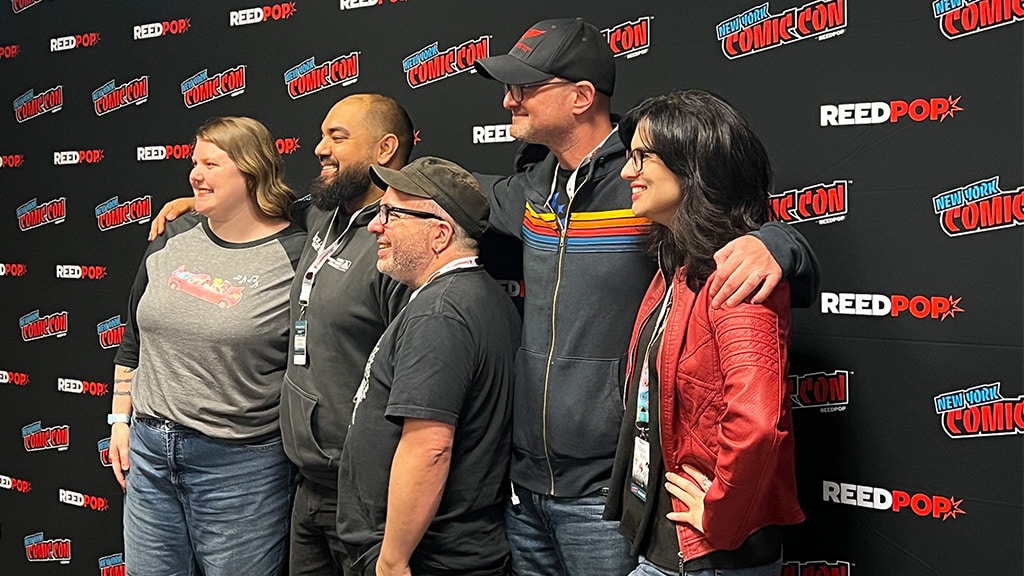
After a couple of unsuccessful guesses from the audience, Nacelle CEO and founder Volk-Weiss — alongside panelists producer Brian Stillman (“Brian with an ‘I'”), marketing and social media Bryan W. Adams (“Bryan with a ‘Y'”), and journalist and author Maude Campbell (“honorary Brian”) — revealed the answer (“non-expanding recreational foam”), shared the deal that changed Jack Nicholson’s mind about joining the Batman cast, and jumped right into exciting reveals and insights on how making The Toys That Made Us turned into creating a toy company.
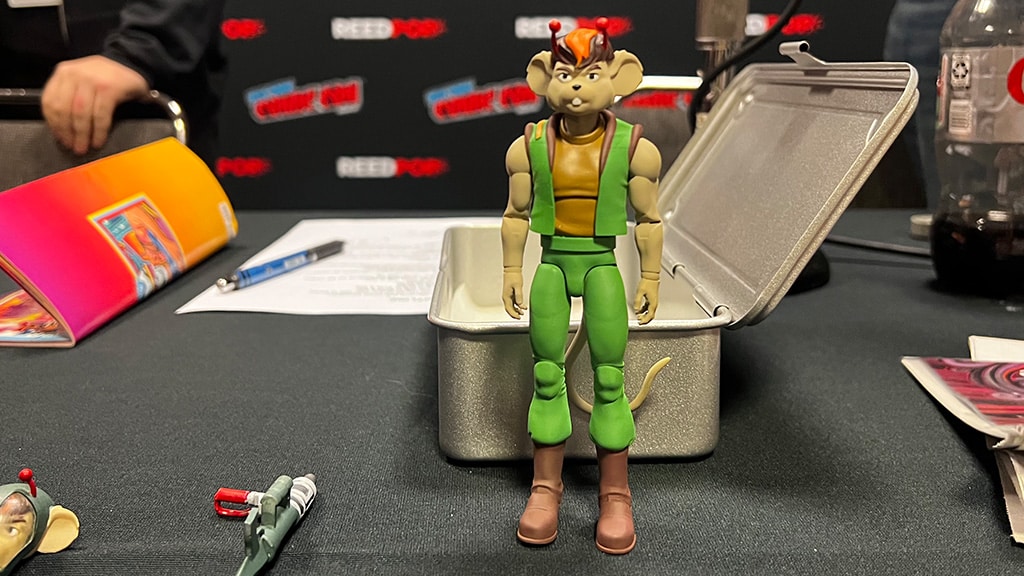
The company’s Nacelleverse includes products from brands like Star Trek, C.O.W.-Boys of Moo Mesa, Sectaurs, Robo Force, The Great Garloo, and — of course — Biker Mice from Mars. Fans of the 1993 series will be excited to see a first look at Rimfire joining the line as an action figureb, including two alternate heads, alternating hands, and accessories. Throttle will join Nacelle’s newer Nacelleverse Minis lines of 3.75-inch figures — which retail for $5.99 each. Both figures will be available for preorder in the spring, Rimfire for $34.99 and Throttle for $5.99.
“Because we get this question all the time on social media, I’m just going to say it out loud for you,” Volk-Weiss says. “Brian, why is it only $5.99? How is it only $5.99? It’s only $5.99 because that’s what it should cost because we can make a profit at that. And it’s five points of articulation, not 22 or more. It has like five paints, not 19. And we can still make money at that price point. So, that’s why it costs that much.”
In addition to a sneak peek at the new figures and animation joining the Nacelleverse, fans got a first look at what’s to come from the highly anticipated fourth and fifth season of The Toys That Made Us.
The series’ fourth season will cover Pokémon, superhero toys, NERF (hence the panel’s kick-off fun fact), and American Greetings, including a look at the unreleased toys from the company’s Madballs toy line.
The fifth season will follow with a look at fast food toys, Ghostbusters (the most-requested episode), Hot Wheels, and Polly Pocket. The latter episode was a result of the research of fellow panelist Campbell, who penned her own Polly-inspired book — in partnership with The Toys That Made Us team — titled The Toys That Made Us: Polly Pocket: An Unauthorized History of Mattel’s Micro Moneymaker. The episode itself dives into the story of how two men named Chris went from diaper specialists to toy creators — and the fact that everyone on the Polly Pocket team refers to the act of moving Polly around the compact as “doinky doinking.”
After the panel, The Pop Insider caught up with Volk-Weiss to talk more about producing both entertainment content and toys, and how the two intertwine.
With everyone constantly able to weigh in on the internet all of the time, at any given moment, how do you balance what the people want and what you want to make content or toys about?
I’m not going to ever do anything that will, if I’m being blunt, will lose money. And by the way, there are many things I’m passionate about that I turn down on a weekly basis because I know no one gives a sh*t but me — or maybe 500 people — and you can’t spend what you have to spend to make an episode or a toy if only 500 people want it. And that really is it.
The other thing I would also add, and this is connected to the first part, but we have to be able to move it forward. For example, people keep saying we should do Battlestar Galactica toys. Diamond [Select Toys] did a great job; and not only did they do a great job, they did like 30 characters. So, what can we do to improve it? Nothing. Technology is probably 20% better, but I have every single Battlestar Galactica figure Diamond made. If another company did what we would do, I wouldn’t buy ’em because I already have ’em. And if you look at our Star Trek line, we very deliberately are making stuff that’s never been made.
So it’s a combination of the two: We can’t lose money on any individual thing. (We do sometimes, don’t get me wrong, but we try to avoid it as best we can.) And then if it’s something I’m excited about, we have to be able to contribute.
Does the creative process of choosing toys to feature on the show at all mirror the process of choosing toys to manufacture?
No. In fact, in many ways, it’s the opposite because for the TV show, it really is such an obviously different medium than making toys that you really need to be making it for other people, for the most part. My Little Pony and He-Man, by the way, were two toys I had 0.0 interest in. People are always surprised — I never was into He-Man. I wasn’t going to do He-Man in the first two seasons. I was convinced by the crew to do He-Man — and I did research and blah, blah, blah — but you make these things for the audience. And usually, I fall in love with it while doing that if I’m not already a fan.
Whereas the toys, because it’s so labor-intensive — and I’m not trying to say making TV shows is cheap, but because it’s so cash-dependent, we have to be so careful. Robo Force is the riskiest thing. Robo Force toys [are] the riskiest thing we have ever done as a company ever. And that barely worked as a toy because it was our first toy, it was three years ago. But it worked, so we could keep going.
Content like The Toys That Made Us and big blockbuster movies like Barbie have fed into the industry’s nostalgia trend from toy manufacturers. Everything that’s old is coming back, getting upgraded, etc. As someone who’s both on the content- and the toy-creating sides of that, how do you see that cyclical content-creates-demand-creates content-creates-demand play out?
It’s not just now, it’s almost always worked like that … I really do consider these shows, like going to grad school, I really do. Of the, let’s say, 2,000 facts I’ve learned making The Toys That Made Us, one of my favorite things that I’ve learned was that a lot of the toys for The Empire Strikes Back were deliberately created to keep the audience excited about Star Wars in the two years it took to make it.
So this isn’t like a new phenomenon. If I’m being honest, maybe I’m not supposed to say this, but being behind the scenes on Star Trek and seeing how when I went to Licensing Expo, I went to this room with 5,000 people where Paramount is showing everything that’s coming. And I’m like, ‘Oh, they do have a plan. Oh, this isn’t an accident.’ They’re talking about what they’re doing in two years, in five years, so all the toy companies and the real retailers can get ready. So that’s what we are now in our own very small way trying to do.
But yeah, a huge hit Barbie movie, that definitely helped sell Barbie. But the interesting thing is Barbie crushed last year, fell off a cliff this year … the same thing happens with Transformers. G.I. Joe really needs a movie that works.
So that’s the thing. It’s just kind of weird. This is not on the subject you’re talking about, but have you seen One Battle After Another?
I haven’t yet. I heard it’s so good.
Top five best movies of this century so far, maybe top three. But it’s all timing. When he made the movie, he didn’t know Trump would be president. He didn’t know Trump would send soldiers and do all the ICE stuff. It was just from the movie’s point of view and the right timing. So it was a hot topic right when the movie came out, and that’s really what you got to hope for. And sometimes it works, sometimes it doesn’t.
