
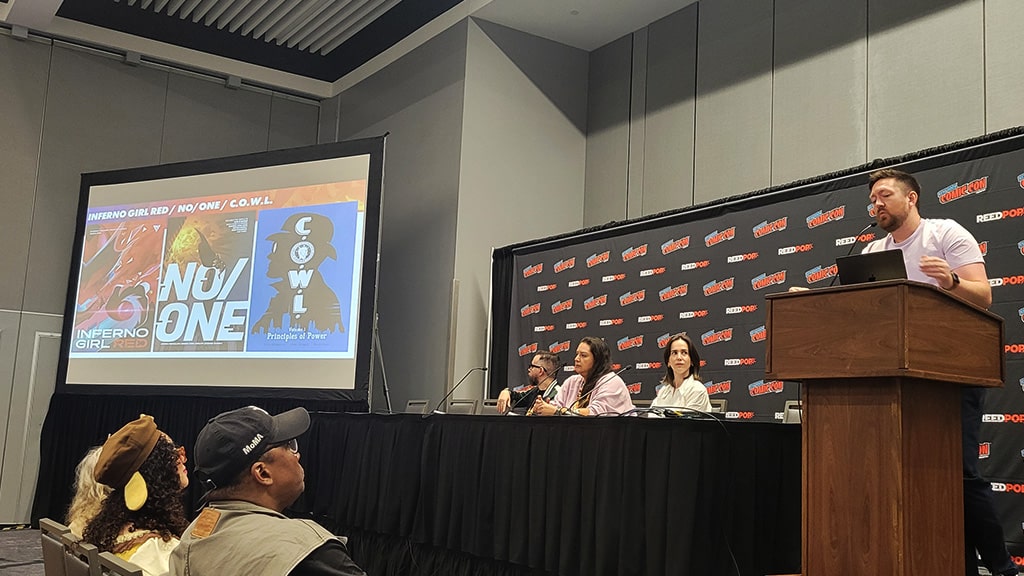
It’s not New York Comic Con (NYCC) without comics, and the team behind Black Market Narrative’s Massive-verse is making its mark by highlighting the studio’s creator-owned projects.
The panel was led by Kyle Higgins (founder of Black Market Narrative and creator of Radiant Black and NO/ONE comics) and featured panelists Kelly McMahon (designer and illustrator for the Massive-verse), Melissa Flores (creator and writer of The Dead Lucky), and Rod Reis (creator of C.O.W.L).
The team shared the premises for the six different projects under the Massive-verse banner: the flagship title and cosmic superhero Radiant Black, the mystery thriller series NO/ONE, the supernatural superhero Rogue Sun, the military science-fiction series The Dead Lucky, the magical girl superhero series Inferno Girl Red, and the ’60s Chicago-inspired C.O.W.L.
Higgins then asked each panelist what they love about the superhero genre. McMahon shares that her appreciation started later on in life: “I grew up a Disney princess girl. So superheroes were something that I came into as a teenager or in my late 20s. And I loved the hopefulness that it held. When I was a kid, to me, it always felt like superheroes were toys. That’s how it was pitched in Australia. And it just wasn’t something I branched into. But as I got older, the narrative was really… I could see something, and I could find something for myself…I still look for that in superhero stories. Because it always has to have a little bit of hope to get started. And especially in 2026, that feels like something that matters.”
Flores followed with her appreciation for the genre’s focus on finding power in hope: “You know, as a kid, you feel so helpless. You feel so powerless. And I love the fantasies that superheroes gave us. That you can change things. That you have the power to change the world. Especially as a kid of an immigrant, a girl, a queer girl in the closet. There was a lot of helplessness and otherness in me. And so the idea that I could look up to these other characters. And know that they have the power to do something that maybe I didn’t feel comfortable doing yet, was always really satisfying to me.”
Reis appreciates the genre’s ability to give readers a break from the real world: “I like how the superheroes can help us to see the best of us. And help us to do what we want, to make our dreams come true. But I also like the escapism and the ability to just have fun, laugh, and forget the world we live in for a little while.”
Higgins pointed to the feelings of security in times of hardship: “I’ve always described it as a combination of fantastic wish fulfillment and the promise of a safety net. And the idea that, especially growing up being picked on, bullied, and all these things that so many of us have gone through. It’s just like the idea that there are these powerful people out there who actually morally are looking out for our best interests. There is something that’s reassuring there.”
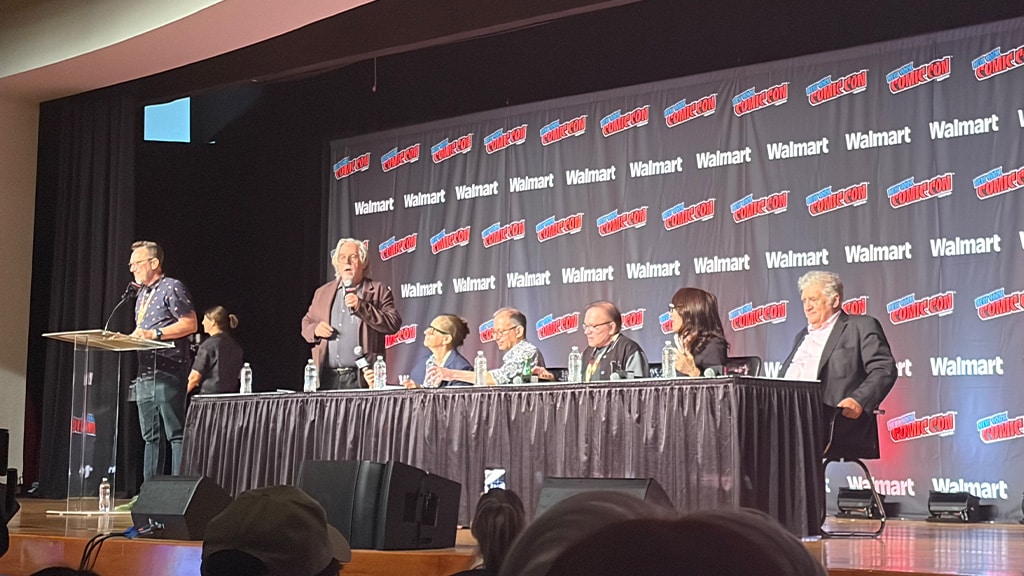
He then asked what the panelists feel is missing from modern superhero storytelling. Flores reflected on history’s influence on superheroes: “You know, we’re looking at the world that exists today. And it wasn’t the world that was, like in the ’60s, ’70s, or ’80s, where a lot of these superheroes started. We live in a very unique situation, where there are a lot of feelings of powerlessness and hopelessness. Everything feels like rushing towards a cliff in a weird way. And even something as small as a penniless writer, or a kid going through a really terrible divorce, or a person with PTSD trying to reintegrate into the world and not knowing how to reconnect with the people she knew. Those are all things that feel unique to today in a way that’s relevant and hasn’t been before.”
Higgins adds: “I feel like the best superhero stories are stories about second chances, in one way or another. It can be a real small regret, or a piece of guilt that the character has, or it can be a real grand one…The way we think our lives are going to go is not the way they go, but I think we all have opportunities to kind of learn from either past mistakes or regrets and figure out how we want to take that energy going forward and put it in a more positive light.”
McMahon shared how modern stories are breaking out of the limitations of the established heroes: “We can’t rewrite Batman and make it more interesting. We can’t rewrite Superman and make it more interesting. Make new narratives, new characters, new stories. Those who have unique, multicultural backgrounds. I love seeing that we’re doing this now because it reflects the world outside our window in a more real way. I love seeing indie comics come up with people’s unique narratives that you can’t put into Batman. You can’t shoehorn these cultural moments into what already exists. So, I think it’s great to see new work.”
The team then discussed the differences of working on contracts for established properties and creator-led projects like the Massive-verse. Higgins shared that it can feel like you don’t need to challenge your storytelling or creative skills when working on projects with established lore and rules.
Higgins compares the process to playing: “Sometimes when you’re doing a book at Marvel or DC, you’re moving action figures on a chessboard in a game that will never end. And you’re just kind of moving things around, and it’s the illusion of change and things like that. It’s always amazing to go play in your favorite sandbox, especially if you were a fan of it growing up, but eventually, you have to leave those toys behind. You gotta leave them for the next person. Whereas when you’re doing something wholly creator-owned, the fact that all of you showed up to this panel, even if you don’t even know what this stuff is, makes this worth doing.
Art is about the relationship that you all bring to the experience of reading or watching what we’re creating. The fact that you can build a community and fandom around something wholly independent. It matters to us. We don’t know any other way to do it.”
To learn more about Black Market Narrative and their latest projects, visit blackmarket.la/universes.
